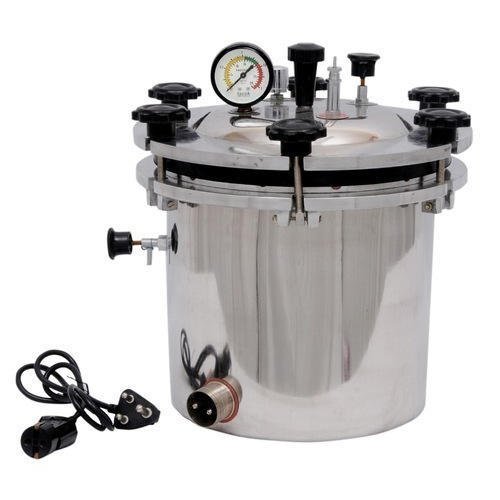
Electric Autoclave
Description:- An electric autoclave uses pressurized steam (121–134°C) to sterilize instruments in healthcare, labs, and veterinary fields.
Description
Specifications
| Parameter | Typical Range / Detail |
| Chamber Material | Stainless Steel 304 or 316 |
| Chamber Volume | 2 L to 150+ L (varies by model) |
| Operating Temperature | 121°C (standard) to 134°C (flash sterilization) |
| Operating Pressure | 15 psi (approx. 1 bar) to 30 psi |
| Power Supply | 110V/220V, Single Phase or Three Phase, 50/60 Hz |
| Power Consumption | 1.5 kW to 6 kW depending on size and features |
| Cycle Time | 15–45 minutes depending on load and cycle type |
| Control System | Microprocessor-based, digital display, programmable |
| Safety Features | Automatic door lock, pressure release valve, temperature sensors, alarms |
| Water Requirement | Distilled or deionized water (2–50 L per cycle) |
| Weight | 25 kg (small tabletop) to 300+ kg (large models) |
| Dimensions (Typical) | Small: 40x40x60 cm; Medium: 60x60x80 cm; Large: varies |
| Sterilization Cycles | Gravity, vacuum-assisted (Class B), flash sterilization |
| Certifications | ISO 13485, CE, FDA (varies by manufacturer) |
Types & Shapes
- By Design: Vertical (Top-loading), Horizontal (Front-loading), Tabletop/Portable.
- By Functionality: Class N (basic, unwrapped), Class B (advanced, wrapped & hollow), Class S (custom cycles).
Sizes & Capacities
| Size Category | Volume Range | Typical Usage |
| Small | 2 – 20 Liters | Dental clinics, small labs, portable use |
| Medium | 20 – 100 Liters | Hospitals, laboratories, diagnostic centers |
| Large | 100+ Liters | Industrial labs, large hospitals, bulk sterilization |
Materials
- Chamber: Stainless Steel (304/316)
- Seals: High-grade silicone
- Exterior: Powder-coated or stainless steel
- Heating Element: Nichrome or ceramic insulated
Product Form & Features
- Electric-powered steam sterilizers
- Available in semi-automatic and fully automatic models
- Digital programmable control panel
- Optional IoT-enabled monitoring features
Usage & Applications
- Human Medical: Sterilization of surgical instruments, syringes, and dressings.
- Hospital & Lab Use: Waste decontamination and microbiology applications.
- Veterinary: Sterilizing surgical tools, bedding, and field clinic equipment.
Sterilization Process
- Standard cycle: 121°C at 15 psi for 15–30 minutes.
- Advanced cycle: 134°C vacuum-assisted sterilization (Class B).
- Steam displacement via gravity or vacuum-assisted flow.
- Validation with chemical or spore indicators.
Advantages
- Eliminates all microorganisms including spores and fungi.
- Eco-friendly alternative to chemical sterilization.
- Automatic monitoring ensures safety and compliance.
- Enables efficient reuse of instruments and tools.
Disadvantages
- Unsuitable for heat-sensitive materials.
- Overloading reduces sterilization effectiveness.
- Higher initial investment for Class B autoclaves.
- Requires reliable power and distilled water.
Precautions
- Avoid sealed containers — explosion risk.
- Do not use aluminum foil wraps.
- Do not overload; maintain proper spacing for steam circulation.
- Inspect gaskets and safety valves regularly.
- Open only after full pressure release; use heat-resistant gloves.
Handling & Maintenance
- Daily: Clean chamber and drain water.
- Weekly: Check for residue and scaling.
- Monthly: Inspect gasket and test indicators.
- Annually: Perform professional calibration and validation.
HS / HSN Code (India)
- HS Code: 8419.20 – Steam sterilizers, autoclaves for medical or laboratory use
- HSN Code: 84192010 – Medical and laboratory steam sterilizers
FAQs
Q1: Can plastics like syringes be autoclaved?
A: Only autoclave-safe plastics such as polypropylene can be used; others may deform.
Q2: Is distilled water required for operation?
A: Yes, distilled or deionized water prevents scaling and extends equipment life.
Q3: Can liquids be sterilized?
A: Yes, but only in vented containers with slow cooling cycles to prevent bursting.
Q4: What is the difference between Class N and Class B autoclaves?
A: Class B autoclaves include vacuum-assisted cycles for wrapped and hollow instruments, while Class N is for unwrapped items only.