Brain Knife
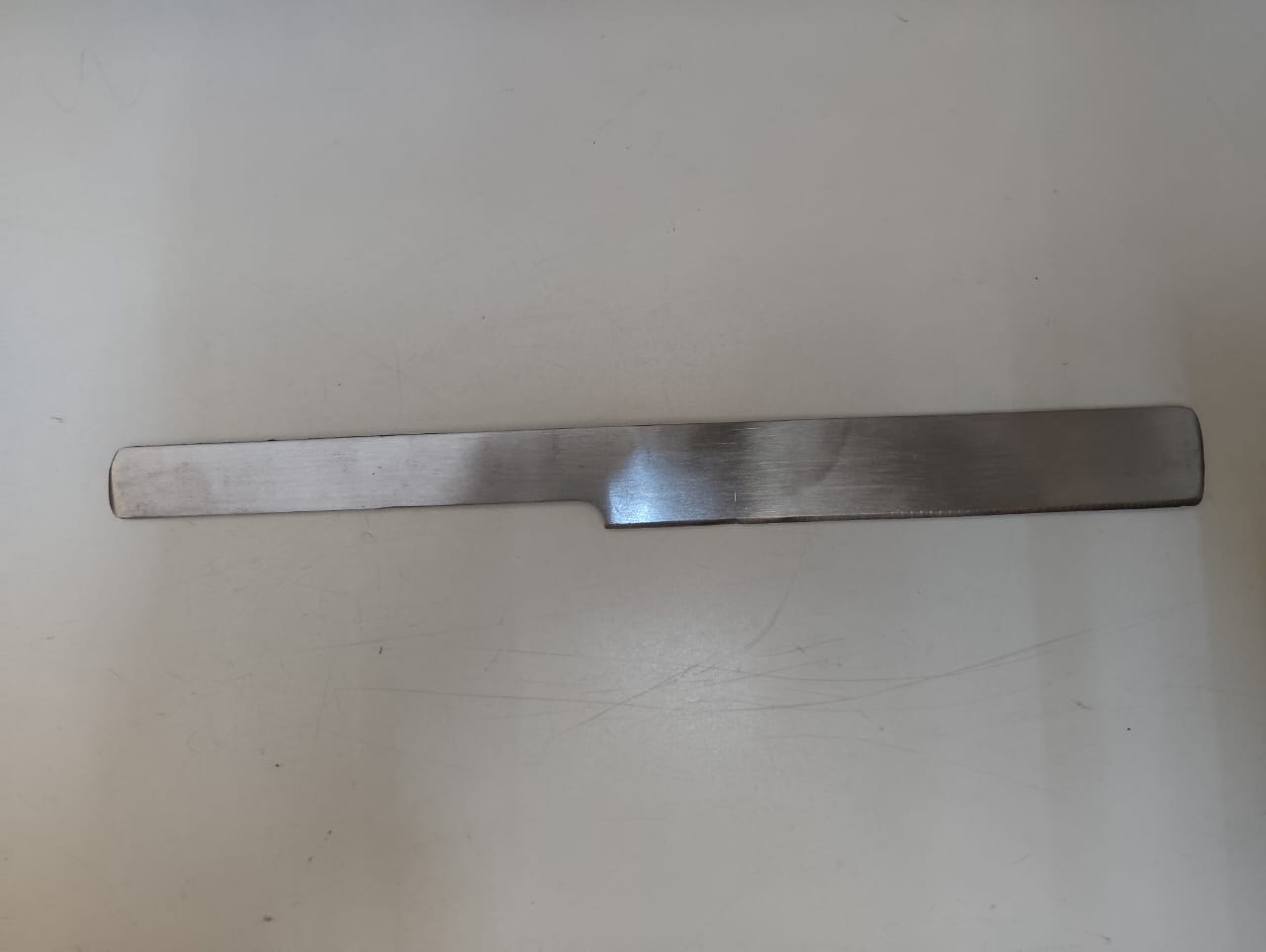
Description:- The Brain Knife is a neurosurgical dissection instrument designed to cut soft brain tissue during postmortem examination or surgical procedures. It typically features a long, thin, flat, stainless steel blade for precise slicing, and is used in autopsy suites, pathology labs, and occasionally in brain surgery for tissue resection.
Description
Specifications
| Feature | Description |
| Instrument Name | Brain Knife / Brain Dissection Knife |
| Blade Type | Straight, smooth-edged |
| Blade Length | 10″ – 14″ (250 – 360 mm) |
| Blade Width | Approx. 1–1.5 cm |
| Handle | Integral or attached (plastic or metal) |
| Edge Type | Non-serrated, razor-sharp |
| Weight | Lightweight (60–150 g approx.) |
| Construction | One-piece or jointed (blade + handle) |
Available Sizes & Shapes
| Size | Blade Length | Total Length | Common Use |
| Standard | 10″ – 12″ | ~14″ | General postmortem tissue slicing |
| Long Blade | 13″ – 14″ | ~16″ | Deep brain tissue dissection |
Shape: Flat, elongated rectangular blade with blunt or rounded tip for controlled sectioning.
Material
- Blade: Surgical-grade stainless steel (corrosion-resistant, non-staining)
- Handle:
- Stainless steel – one-piece integrated handle
- High-grade plastic – ergonomic, non-slip grip
- Wood – traditional variant (less common)
Category & Product Form
- Category: Surgical / Postmortem Instruments → Cutting Instruments
- Subcategory: Autopsy Knife / Pathology Knife
- Form: Manual handheld precision cutting tool
Usage & Applications
- Used in postmortem and neuropathology labs for brain tissue slicing and sectioning.
- Helps in forensic medicine for examining trauma, lesions, or brain diseases.
- Used in surgical histopathology for tissue sampling and specimen preparation.
- Commonly utilized in academic and research labs for anatomical dissections.
Advantages
- Long blade enables full cross-section cuts of brain tissue.
- Razor-sharp edge provides smooth, clean slices for microscopic studies.
- Non-corrosive stainless steel ensures longevity and hygiene.
- Ergonomic handle improves comfort and control during extended use.
- Lightweight and balanced design suitable for precise dissection.
Disadvantages
- Not suitable for hard tissues like skull or bone.
- Requires periodic sharpening to maintain performance.
- Incorrect handling may cause accidental injury.
- Limited to soft tissue cutting applications.
- Requires manual effort; not compatible with powered tools.
Precautions
- Wear cut-resistant gloves during use.
- Sterilize before and after every procedure.
- Store safely in sheath or guarded tray to prevent cuts.
- Avoid use on bone or hard surfaces to prevent dulling.
- Inspect blade regularly for dullness, nicks, or defects.
Sterilization & Handling
| Material Type | Sterilization Method |
| Stainless Steel | Autoclave (121°C for 15–20 minutes) or chemical disinfectant soak |
| Plastic Handle Type | Cold sterilization or autoclave-compatible depending on design |
| After Use | Wash with enzymatic cleaner, rinse, and dry thoroughly |
| Storage | Store in dry tray or protective blade guard case |
Human Applications
| Field | Application Example |
| Human Pathology | Brain cross-sectioning during autopsies |
| Forensic Medicine | Neurological forensics and brain trauma assessment |
Veterinary Applications
| Field | Application Example |
| Veterinary Pathology | Animal necropsy and brain tissue examination |
| Academic Research | Laboratory dissections and educational studies |
HSN / HS Code
| Region | HS/HSN Code | Description |
| India | 9018.90 | Surgical instruments, others |
| International | 9018 | Medical or veterinary instruments and appliances |
FAQs – Frequently Asked Questions
Q1: What is the difference between a brain knife and a regular scalpel?
A: Brain knives have longer, wider blades for smooth slicing of soft brain tissue, while scalpels are for short, sharp incisions.
Q2: Can brain knives be sterilized in an autoclave?
A: Yes, stainless steel brain knives are fully autoclavable and reusable.
Q3: Are disposable brain knives available?
A: Most are reusable, but some models feature hybrid plastic-steel disposable designs.
Q4: Is it used only in postmortem exams?
A: Primarily, but it’s also used in neurological research, forensics, and academic dissections.
Q5: What is the ideal length for standard use?
A: A 10″–12″ blade with ~14″–16″ total length is ideal for most pathology applications.