Babcook Forceps
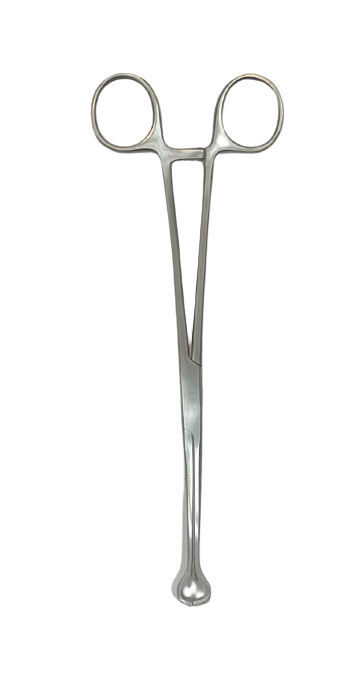
Description:- Babcock Forceps are surgical instruments used to grasp delicate, soft, or tubular tissues (like intestines or fallopian tubes) traumatically. They feature rounded, fenestrated jaws with no sharp teeth, and a ratchet lock for secure handling during procedures.
Description
Specifications
| Feature | Description |
| Instrument Name | Babcock Tissue Forceps (With Lock) |
| Jaw Type | Fenestrated (open ring), smooth edges |
| Locking Mechanism | Ratcheting-style lock for secure hold |
| Handle Type | Ring handle with thumb and finger grip |
| Tip Width | 5 mm (laparoscopic), 8–10 mm (standard) |
| Length Options | 6″–10″ (standard), 330 mm–450 mm (laparoscopic) |
| Material | Medical-grade stainless steel |
| Finish | Matte / Satin (non-reflective) |
| Reusability | Yes (fully autoclavable) |
| Sterilization | Required before each use |
Available Sizes & Variants
| Type | Length | Application |
| Standard | 6″–8.25″ | Open surgery (GI, OB/GYN) |
| Laparoscopic | 330 mm–450 mm | Minimally invasive laparoscopic procedures |
| Bariatric | 450 mm+ | Deep abdominal access in bariatric surgery |
Material
- Medical-grade stainless steel (non-corrosive and autoclavable).
- Optional silicone-coated handles for better grip (on select models).
Category & Product Form
- Category: Surgical Instruments → Grasping & Holding Instruments
- Form: Reusable hand-held instrument with locking mechanism
Usage & Applications
- Used in general surgery, GI procedures, gynecology, and urology.
- Commonly used for handling delicate organs such as intestines, appendix, fallopian tubes, and bladder walls.
- Also applicable in veterinary surgery for grasping small animal organs or tissues without trauma.
Advantages
- Atraumatic handling – minimizes tissue injury.
- Ratcheting lock ensures stable, hands-free grip.
- Multiple sizes and laparoscopic variants available.
- Fully sterilizable and reusable.
- Ideal for hollow and tubular structures.
Disadvantages
- Not suitable for heavy or fibrous tissue.
- Over-tightening may cause minor trauma.
- Requires thorough cleaning to prevent locking malfunction.
- High-quality laparoscopic models can be costly.
Precautions
- Lock gently; avoid excessive pressure.
- Clean the ratchet mechanism thoroughly after each procedure.
- Sterilize before every use.
- Do not use if tips are misaligned or lock is jammed.
Sterilization & Handling
- Cleaning: Use enzymatic cleaner immediately after surgery.
- Sterilization: Autoclave at 121°C for 15–20 minutes.
- Storage: Keep in dry, sterile trays.
- Lubrication: Apply surgical-grade lubricant on hinge or ratchet as needed.
Human & Veterinary Applications
| Use Area | Application Example |
| Human Surgery | Intestinal resection, gynecology, laparoscopic procedures |
| Veterinary Use | Grasping intestines or organs in cats, dogs, and large animals |
HSN / HS Code
| Region | HS/HSN Code | Description |
| India | 9018.90 | Surgical instruments, others |
| International | 9018 | Instruments/appliances for medical or surgical use |
FAQs – Frequently Asked Questions
Q1: Is Babcock Forceps traumatic to tissue?
A: No, it’s designed for gentle tissue handling without crushing or tearing.
Q2: Can Babcock Forceps be autoclaved?
A: Yes, stainless steel versions are fully autoclavable and reusable.
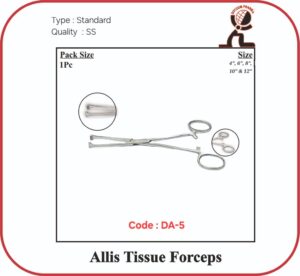
Q3: What’s the difference between Babcock and Allis Forceps?
A: Allis has teeth and is more traumatic; Babcock has smooth fenestrated jaws for delicate tissue.
Q4: Can this be used in laparoscopic surgery?
A: Yes, laparoscopic models with 330–450 mm shafts are available for minimally invasive procedures.
Q5: Are locking forceps better than non-locking?
A: Yes, the locking type maintains a firm hold during long surgeries without hand strain.