Spermoscope in Artificial Insemination
Introduction
Artificial insemination (AI) has become a standard practice in modern livestock breeding. It is now widely used in cattle, goats, and sheep to improve genetics, boost productivity, and manage reproduction in a more controlled way. Unlike natural mating, AI allows farmers to introduce superior genetics from selected bulls or bucks into their herds without the need to physically maintain male animals. This approach reduces costs, improves disease control, and supports better herd management.
But there is a catch. The success of artificial insemination depends heavily on semen quality. Even if every other step in the process is correct, poor-quality semen will lower conception rates. Weak motility, low concentration, or abnormal sperm morphology often result in wasted cycles, additional veterinary visits, and economic losses for farmers. In many rural areas, this also means longer calving intervals, reduced milk yield, and lower overall productivity.
For this reason, semen evaluation before insemination is no longer optional. Farmers and veterinarians need practical ways to check semen quality in the field, without relying solely on laboratory facilities. This is where the spermoscope becomes essential.
Why Checking Semen Quality Matters
Every insemination should begin with semen evaluation. This is not just a routine step but the foundation of reproductive success. Three main parameters guide the assessment:
-
Motility: Whether sperm cells are moving actively and in the right direction. High motility means a greater chance of fertilization.
-
Concentration: The number of sperm cells present in the sample. Low concentration reduces the chance of successful fertilization even if motility is good.
-
Morphology: The structure of sperm cells. Abnormal forms, such as bent tails or misshapen heads, reduce the effectiveness of insemination.
When any of these factors are compromised, fertility outcomes suffer. A quick check in the field helps veterinarians avoid using poor-quality semen. This not only increases the chance of success in the first cycle but also prevents farmers from losing money and time on repeated inseminations.
Features of the Spermoscope
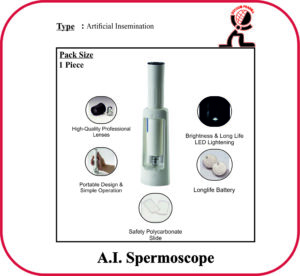
The spermoscope is designed for veterinary field use. Unlike traditional laboratory microscopes, it is built with portability, durability, and ease of use in mind. Some of its important features include:
-
High-quality lenses: These provide clear and sharp visualization of sperm motility, allowing for accurate assessment.
-
Portable design: Lightweight and compact, making it easy for veterinarians to carry during farm visits.
-
LED lighting system: Ensures bright and consistent illumination of samples, even in low-light field conditions.
-
Rechargeable battery: Allows use in remote areas with no access to electricity, which is especially useful for rural veterinary practice.
-
Polycarbonate slides: Strong and reusable, making them safe for daily use without the risk of frequent breakage.
Together, these features make the spermoscope a practical, field-ready tool that bridges the gap between laboratory accuracy and on-farm convenience.
Benefits in Veterinary Practice
In real-world conditions, veterinarians work under time pressure. Farmers expect results quickly, and every missed breeding opportunity affects productivity. The spermoscope helps in several ways:
-
Faster decisions: Samples can be checked immediately after collection, eliminating the delay of sending them to a laboratory.
-
Better conception rates: Using semen with good motility and concentration increases the chances of pregnancy in the first attempt.
-
Cost savings: Farmers avoid unnecessary repeat insemination attempts, saving money, time, and effort.
-
Simple operation: The device is easy to use and does not require advanced technical training. This makes it suitable for both busy clinics and on-farm conditions.
In short, the spermoscope allows veterinarians to make confident, evidence-based decisions on-site.
Role in Breeding Programs
The spermoscope is widely applied in dairy herds, goat breeding programs, and sheep husbandry. Each of these sectors benefits in specific ways:
-
Dairy herds: Artificial insemination improves milk yields by introducing superior genetics. Semen evaluation ensures that only viable semen is used, which supports consistent calving intervals and better herd productivity.
-
Goat breeding: In goat farms, semen evaluation helps maintain strong genetic lines and improves fertility outcomes in small ruminants. This is particularly useful in breeding centers focused on high-yield dairy goats.
-
Sheep production: In sheep husbandry, artificial insemination helps introduce new genetics across flocks without transporting rams. Spermoscopes ensure that the semen used has good motility, improving lambing percentages.
By adding semen evaluation to AI programs, veterinarians and farmers strengthen breeding outcomes. They can identify problems early, adjust protocols, and avoid repeated inseminations that waste resources.
Practical Example from the Field
Consider a dairy veterinarian visiting a farm during the peak breeding season. The farmer has collected semen but is uncertain about its quality. Instead of sending the sample to a distant laboratory, the veterinarian uses a spermoscope on-site. Within minutes, they confirm motility and concentration, advising the farmer whether the sample is suitable for insemination.
In this scenario, the farmer saves time, avoids a wasted cycle, and increases the chance of conception. The veterinarian, in turn, provides faster service and builds trust by offering immediate, reliable guidance.
This is the practical value of the spermoscope. It transforms semen evaluation from a laboratory-only procedure into a routine, accessible step in daily veterinary practice.
Impact on Farmers and Herds
For farmers, the benefits of using semen evaluation tools go beyond improved conception rates. By reducing failed attempts, they cut down on feed and labor costs linked to open animals. Calving intervals remain steady, milk production is optimized, and herd productivity improves. Over time, this also leads to better financial returns.
For veterinarians, the spermoscope improves efficiency. Instead of relying on trial and error, they can give precise recommendations backed by immediate evidence. This strengthens their role in herd reproductive management and builds stronger farmer-vet relationships.
Conclusion
The spermoscope is more than a piece of equipment. It is a practical field tool that supports veterinarians and breeders in artificial insemination programs. By making semen evaluation quick and reliable, it helps improve conception rates, prevents economic losses, and supports better herd management.
Farmers gain by saving time and resources, while veterinarians gain by providing accurate, timely services. In a sector where every breeding cycle matters, the spermoscope ensures that artificial insemination is carried out with greater confidence and higher success rates.